frequently asked questions about mike severns diving maui
Mike Severns Diving BlogScuba dive with the experts into the amazing waters of Maui…

Atlas crabs in their coral homes – what goes on under there?

No Comments »

As promised in my last article, there is more Atlas crab behavior to share. To recap, I had collected a few of these dead coral pieces (which I will sometimes refer to here as rocks) with their resident crabs and kept them in an aquarium for a couple days before putting them back in their neighborhood. Because they are not in ID books, I wanted to try and find out what species they were, and to learn what they are doing under there!

Atlas crab eating square

Even though the crabs were in a foreign environment (a small aquarium) they quickly started moving their dead coral homes around. Next, they all began picking at whatever they could find on their or their neighbor’s rock. Using their big claws (chelipeds) they picked at the rock and put whatever they were getting in their mouth.

One other cool thing that the video showed was the amount of current that the crab generates to move water across its gills. As divers we don’t even notice this underwater when looking at a crab. We see all the appendages moving up by its face, but we don’t see the current. Because the bottom of the tank was clean, the current was very apparent when the few pieces of debris by the crab’s mouth were blown out of the way. Crabs create this current to force water over their gills so they can “breathe.” Normal water movement is not enough.

(In this photo an Atlas crab is picking something edible off of the rock. You can see some of the debris that is flying around due to the current the crab is producing with his head appendages. You can see video of the crab feeding here).

By chance I had collected one rock occupied by a male and two others by females. That made for some interesting interactions. When put in the same tank they probably began communicating chemically right away. Then the male began performing his courtship duties which included intermittent vibrating of his large claws and some of his other legs. The vibrating could have been sending a vibrational signal to the female, and, once they were in contact, a tactile signal as well. They both flapped their abdomens and then slowly they inched into their mating position which is basically belly to belly – with 20 major appendages to keep out of the way in the process. It was kind of excruciatingly too intimate to watch, but I posted the video here. After about fifteen seconds  they suddenly separated and bolted to their separate holes. In the photo below the male crab on the right is just beginning to reach for the female on the left. It took them another whole minute to even get into position.

Male and female reaching

Atlas crab with eggs

The other female crab that I had brought in was carrying a batch of well-developed cranberry colored eggs, and she could not come out of her hole fast enough to begin aerating them. The developing embryos inside the egg capsules require oxygen which diffuses through the egg capsule membrane, so she must keep water moving across them or the embryos will suffocate.

The female that I watched spent most of her time vigorously flapping her abdomen open and closed, and the eggs that were attached to it were agitated along with it. She also periodically moved her claws and legs through the eggs to clean them. All the while she was creating a current in the water by moving her head appendages which helped to aerate the eggs too.

(In this photo from the video, the female Atlas crab’s abdomen is fully extended as she opens and closes it to move water around the eggs and to keep them aerated).

Also while I was videoing, a juvenile Atlas crab emerged from one of the rocks “operated by” an adult. It is likely that juveniles live in coral pieces that are carried by the adults. Do they leave and find their own piece of rubble once they are mature, or do some wait in line to take over the existing coral if the resident crab is an aging individual? Do they remain in the same rock their whole lives, enlarging the hole as they grow or do they try on different unoccupied rocks or trade/fight for already occupied rocks?

And, what do they eat? Do they mostly scavenge underneath their coral homes and supplement their diet with what grows on their  homes? Do they “farm” the algae and organisms growing on their home coral by picking off undesirable species and allowing desirable species to grow?

What a world of their own these little crabs have underneath their dead coral pieces… so many unknown details of their lives.

Atlas Crabs Move Their World

No Comments »

Atlas crab thumbnail


In Greek mythology, Atlas was the Titan
condemned by Zeus to hold up the celestial sphere.


dead meandrina with crab-Kamaole 3

Trail made by an Atlas crab (Actumnus obesus) moving its coral home.

Have you seen a kind of scruffy drag mark on top of the sand, only to find what looks like a rock or piece of coral rubble at the end of it? I’d seen these for years and every time I turned one over all I saw was a perfectly circular hole in the rock that dog-legged out of sight, making whatever was in there difficult to see. I assumed it was a kind of crab, but it wasn’t until a few months ago that I collected some of these coral pieces to observe in a holding tank.

The little crab that inhabits this coral rubble isn’t in popular Hawaii ID books, so it took the help of several people in the islands and on the mainland to match this crab with its name. It turns out to be Actumnus obesus Dana 1852, and – even though it is found throughout the Indian and West-Pacific Oceans – it was first collected and described from Maui! In 1852!


It always surprises me that people found things like this without SCUBA so many years ago. During the United States Exploring Expedition of 1838-1842, ship naturalists onboard the Albatross dredged these crabs “south of Molokai and near Lahaina.” It makes sense that these crabs were collected during the Maui part of that worldwide expedition as they are very common at diving depths along Maui’s leeward shore. The relatively protected leeward coastline of Maui and the fine sand allow the crabs to easily crawl around in search of food without getting thrown around by surf.


crab in rock for blog 5

A coral nodule turned over to see the Atlas crab in its hole.

When Actumnus obesus was described, it was noted to have a deep, convex body  (thus, the species name obesus, meaning fat) and short, stout claws. But since the dredgers did not see the crab in its natural environment, there was no description of how it used those adaptations. It wasn’t until over 100 years later that Melbourne Ward reported that another species of Actumnus excavated a burrow in a dead coral piece and then moved the coral from place to place.

Since then, two other species of Actumnus have been reported to exhibit similar behavior (some of them using pieces of coral that are still alive) (Johnson et. al., 2008), and now we’ve learned that Actumnus obesus is the fourth Actumnus species known to do so.


With the crabs in their little holding tank and me looking up at them while lying comfortably on my back beneath it, I was able to spend hours watching and videoing the crabs move about. Each crab would emerge from its hole, position its legs and claws and then abruptly thrust its claws and next two pairs of legs at the bottom of the tank propelling its coral piece rearward (while holding the coral with the last two pairs of legs). It was such a surprise! I had expected them to drag the piece of dead coral (like a hermit crab drags its shell), not pop it up off the bottom in spurts. Now the deep body and the large claws make sense – they are used to heft their home around!

You can see what I saw here: http://www.youtube.com/watch?feature=player_detailpage&v=OblcmLs2jsQ

To understand this feat a little better, I weighed one of the crabs and one of the average-size coral pieces. With the crab (wet) at less than a gram and the coral (dry) at 76.5 grams, the crab is lifting more than 150 times its own weight. That equates to a 150 pound person lifting 11 tons!


claw close-up

The granular surface of the claws is used to rasp a hole in the coral nodule.


Their deep body houses the muscles necessary for the large claws to do the heavy lifting. That makes sense. Now, how do they make that hole in the coral?

You can see that the carapace and the claws are covered with tiny pointed granules like the teeth on a rasp. Using their claws (and possibly their carapace) they excavate the perfect size hole in their coral home, and are presumably able to enlarge the hole as they grow.

The extreme ease with which they slip into and out of their hole is another example of nature’s perfection. Who knows how many more adaptations they have for their life within and underneath their coral homes?


In addition to watching their means of coral transport, I was also fortunate to see a female emerge from her rock and aerate her eggs, a male crab scraping material off of the rubble and eating it, and a pair of crabs perform a courtship ritual and get into their mating position. It was a warm and dry front-row seat to their precious world underneath their coral homes. I will post more descriptions and videos of their private lives soon.


Thanks to Cory Pittman and John Hoover for help with identification research and to Peter Castro for examining the photos and identifying this crab as Actumnus obesus Dana 1852. It is figured in Edmondson, C.H. (1962) Xanthidae of Hawaii. Occasional Papers of Bernice P. Bishop Museum, 22(13), 215-309 [p. 290, figs. 27a, 28a].

Johnson, Peter R., Davie, Peter J. F., Neil, David T. and Fellegara, Ida (2008) Excavation, habitation and transportation of massive corals by the crab Actumnus setifer (Crustacea: Brachyura: Pilumnidae) in Moreton Bay, Queensland. Memoirs of the Queensland Museum – Nature54 1: 261-271.

Ward, M. 1942. A new genus and eight new species of Brachyura from Mauritius and the Chagos Archipelago. Mauritius Institute Bulletin 2: 39-48.


How the Octopus cyanea got its name – probably

3 Comments »

The day octopus (Octopus cyanea) is so common in Hawaii that anyone who dives here regularly has seen heaps of them over the course of their diving career. They range from mottled brown to maroon to sometimes even white. But the other day I saw one that was practically glowing with a bright cyan color on its funnel. And it struck me – maybe THAT’S why the author named it cyanea! Why didn’t I ever know that?

Octopus cyanea with cyan sheen

Octopus cyanea with cyan sheen. Photo by P. Fiene

I guess I’d seen a cyan sheen on the body and arms of them in some of my and others’ photos, but it wasn’t until I saw this bright patch on the funnel that it made me stop and think.

I went online and started searching for the etymology of the name. Cory Pittman located the original 1849 description online, but back then descriptions were much less detailed. Here’s the entire description of this species, which could fit on a single index card:

Catalogue of the Mollusca in the collection of the British Museum.
By British Museum. Dept. of Zoology, John Edward Gray
Octopus cyanea
Body (in spirits) ovate, above rather granular, beneath smooth. Ocular tubercle rugose, superior. Arms rather elongate, conical; order of length, 2, 4, 3, 1. Cups large; the tenth to the twentieth of the second and third pairs of arms larger, equal-sized; the lowest, especially of the ventral arms, one-rowed. Web broad, minutely granular above, especially between the upper arms.
Hab. Australian seas.
a. Coast of New Holland. In spirits. Presented by J.B. Jukes, Esq.
b. ? _______ ? In spirits?

And, there was no section for the etymology (origin of the name) that is standard in scientific descriptions today.

So, I Googled some more. Further reading showed that Cyane was also the name of a mythical Greek nymph. Could this be the inspiration behind the name? To confuse things further, the name Cyane means dark blue. So was the octopus named for the Greek nymph only? Or was it named for the the nymph, Cyane, because Cyane means dark blue?

Oh, sure, I could have just looked in John Hoover’s Hawaii’s Sea Creatures where he blurts out the answer, but I’d completely forgotten to check the most obvious source!

octopus cyanea Jeremy Bricco

Octopus cyanea showing cyan sheen. Photo by Jeremy Bricco

I continued my online search. In the Catalogue of the Mollusca, where the original description of cyanea was published, the author described nine more species of octopus and he named seven of them after other mythical Greek figures (aegina, eudora, cassiopeia, cephea, geryonea, polyzenia) or female Greek royality (berenice), with no apparent connection to any morphological features of the particular octopus to which they were attached. Other researchers were handing out names from Greek mythology as well, so maybe cyanea was just assigned a mythological name at random.

In addition, Gray described Octopus cyanea from specimens preserved “in spirits,” not from living animals. In looking at many photos of living Octopus cyanea, such as this one taken by Jeremy Bricco, it appears that the cyan sheen is only apparent when light strikes the skin at a particular angle, suggesting that it’s the product of refraction of light from structures in the octopus’ skin or mucus, rather than reflection of light from pigments in the skin. All this to say that the cyan would likely not have been visible to Gray when he looked at the pale body of the preserved animal.

How perfect is that! The author named this species after a mythological nymph, Cyane, whose name means dark blue, likely without knowing that the animal actually exhibited this color in life!

Incredible Japanese pufferfish nests and the possibility of similar nests in Hawaii

5 Comments »

The same day that I posted the previous article gushing over the perfection of male-constructed tilapia nests
on Maui, a blog article on a Japanese pufferfish nest discovery was posted and picked up by the news media.
http://www.spoon-tamago.com/2012/09/18/deep-sea-mystery-circle-love-story/
Since then it has been re-blogged and re-reported hundreds of times. The story is so popular because it appeals not only to fish scientists and divers, but to artists as well, and if you’ve seen the photos you know why. This nest put the modest tilapia fathers’ nests (in mud) to shame.

Nest created in sand by male pufferfish in Amami Oshima, Japan (Discovery and photo by Youji Ookata).


Not only was the pufferfish nest huge (6.5 feet across) taking hours to construct, but it brought to mind the concentric design of a mandala – the circular figure representing the entire universe in Hindu and Buddhist symbolism. For all its detail and perfection, this nest could symbolize this very thing.

Photo by Youji Ookata. This pufferfish appears to be a member of the genus Torquigener, but its species name is unknown at this time.


Intriguing questions arise from this discovery by Youji Ookata, a passionate Japanese underwater photographer who has spent over 50 years exploring the ocean. In only 80 feet of water, how did such a creation go unreported until now? What species of fish is making this nest? Though not identified in the photos, the puffer appears to be in the genus Torquigener.

I queried Dr. Jack Randall who in turn asked a Japanese colleague who works on pufferfish about the identity of this puffer. His colleague reported seeing the spawning behavior himself and confirmed that he thought it was a Torquigener, but he was not familiar with the species. He intends to revisit the island during the next spawning season in hopes of making an identification.


What makes this even more exciting is that we have two species of Torquigener right here in Hawaii: T. florealis which is also found in Japan, and T. randalli (named in honor of Dr. Jack Randall) which is endemic.

Torquigener florealis (Photo by Keoki Stender, left) and Torquigener randalli (Photo by P. Fiene, right)

It seems to me that if tilapia of different genera (and even more distant relatives of theirs such as sunfish) all make the same type of circular nest, then members of the Torquigener genus and its relatives might make nests similar to the Japanese puffer.

If the nesting season is only during a certain moon phase, occurs only once a year, and/or is in deeper water than recreational divers typically dive, perhaps we have missed a similar sight here in Hawaii. Has anyone seen either of these puffers nest or spawn here in Hawaii?

If you can read Japanese, here is Youji Ookata’s original post: http://ookatayouji.amaminchu.com/archives/2012/09/post_459.html

Mud micro-atolls or ??

2 Comments »

tilapia nests in north Kihei

While driving along North Kihei Road, something caught my eye in the standing water behind the big dune near the Whale Sanctuary Building. I knew it couldn’t be, but they looked just like the coral micro-atolls in the Olowalu area. But these were in fresh/brackish water where corals would not be living, so what could they be? I had to know. I went back with my camera, photographing the rings and trying to see any indication of what might have made them. But the water was murky, and other than some tiny creatures zipping around and touching the surface of the water from beneath, I saw nothing.


A  Google search of “mud rings” yielded only the (apparently) well-known item used in electrical installations. So I started to ask around instead. As usual, Cory Pittman was able to point me in the right direction. They were fish nests! Made by an introduced group of fish called tilapia.

The Mozambique tilapia (Oreochromis mossambicus), one of the tilapia introduced to Hawaii in the 1950s.


Tilapia is the generic term for a group of African cichlids, a huge family of freshwater fish found worldwide. According to Hawaii’s Native and Exotic Freshwater Animals by Mike Yamamoto and Annette Tagawa at least 10 species of tilapia have been introduced to Hawaii since the 1950s as a source of food, to control vegetation overgrowth, and to provide recreational opportunities. Because they are tolerant of brackish water, low oxygen, high temperature, and high ammonia concentrations, they can survive in wetland areas with limited circulation, in drainage ditches, and in areas of standing water close to the coastline.


tilapia nests in north KiheiLike their damselfish relatives, tilapia don’t just release their eggs and sperm into the water, but lay their eggs on the bottom and fiercely protect them during development. It is the male’s job to make a nest and attract females to lay their eggs within. As described in an online aquaculture article, the male “excavates a nest in the pond bottom.” This is a pretty weak description for a skill that results in such precisely circular nests. I am certain that even with two hands and a whole day I would not be able to construct such a perfect ring.


So how does he do it? While I wasn’t able to find a decent video online showing male tilapia nest building, I did find one of a male sunfish (a close relative) doing so in an aquarium. View the nest building technique. It turns out that the male uses his tail fin to make this work of natural art.


These beautiful nests go unnoticed because they are normally below the surface. Because of tidal fluctuation and low water flow, the rims of the nests were exposed on this day.


Reef dynamiting and seawall building off of Kihei’s Kalama Park – and what it teaches us for Ukumehame and Olowalu

3 Comments »
Blowing up the Kalama Park Reef

A demolition charge blasting the coral reef in front of Kalama Park to make a better swimming beach.
Photo taken around Sept. 14, 1945 by a member of Navy underwater demolition team 14


Forty years ago a fanciful little piece titled “Our Living Reefs” filled some space in a corner of a page in the The Maui News. It contained flowery words such as “rainbow profusion” and “underwater fairyland.” But it also contained eight surprisingly wise words that we’ve seemingly forgotten today. The eight words were “Not all Maui’s shoreline is protected by reef…”


It is common for Maui’s reefs to be appreciated for their beauty, for providing food, and for attracting visitors, but it is far less common for us to recognize the reef’s ability to protect the coastline. This protective ability of a reef was brought to light in Kihei beginning in the 1940s. A fascinating series of events at Kalama Park began a chain reaction along the coastline to the north and taught a lesson that we should consider in our actions at Ukumehame and Olowalu today.


Prior to WWII Kalama Park was a popular weekend destination for residents who came to enjoy its beautiful beach and shallow water. It was even touted in one newspaper caption as “Maui’s Waikiki Beach!” Can you imagine? It’s hard to believe today because no beach even exists at Kalama Park except for a small damp sliver of sand at low tide. But back then a luxurious wide beach extended from Kalama Park to the north for miles.


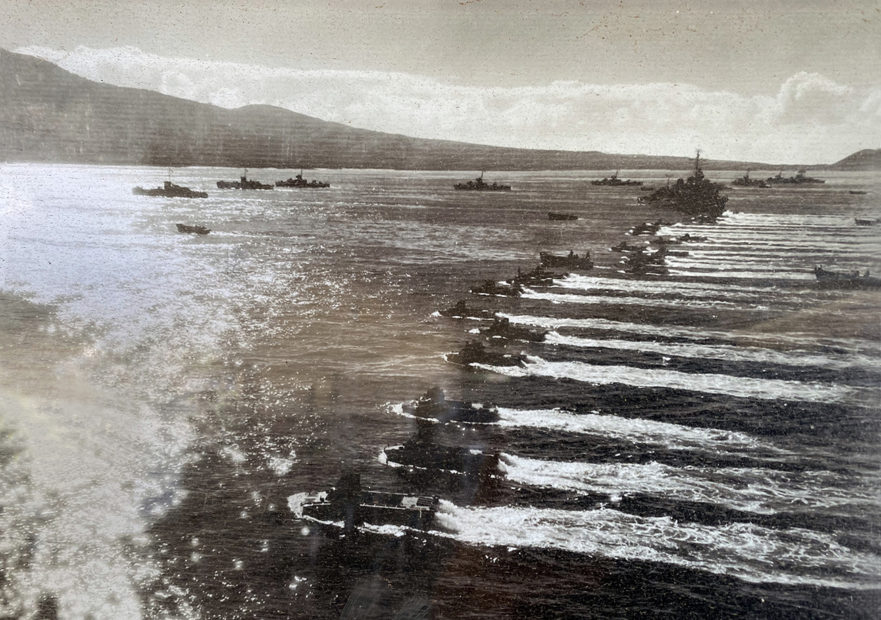
During WWII Kalama Park was taken and used as a staging area by the US Army for amphibious assault training. In order to get military craft ashore, the Navy blasted channels in the coral reef offshore. After the war ended, Maui County requested that the Navy blast the rest of the reef in order to make the beach a better “swimming beach” for beachgoers. The Navy complied and in 1945 a section of reef totaling 270,000 square feet or 4-and-a-half football fields was blasted toward the sky.


Kalama Park seawall at low tide – summer 2012

With the reef gone, it did not take long for nature to begin rearranging the sand according to her laws. Because many people felt that the beach was disappearing at Kalama Park, a fortification was proposed, and in 1970-71 a revetment (sloping seawall) was constructed. At that time beaches to the north along Halama St. were still broad and healthy. Halama Street resident Dave Sharp remembers his family riding their horses on the beach, and resident Micky Palmer recalls 70 feet of state land extending seaward from the edge of her family’s property. But the seawall at Kalama Park further upset nature, and the altered ocean flow began removing sand from Halama St. yards as well, forcing residents to shore up their land with seawalls too.


Coastal hardening at Ukumehame, Maui, Aug. 26, 2012

As I type this, coastal hardening with a concrete barrier (seawall) and boulders is occurring at Ukumehame.  I have heard the Ukumehame hardening referred to as a band-aid solution. But a band-aid promotes healing. A seawall does nothing to promote healing; in fact, it does damage to adjacent areas.

This hardening is bound to have an effect on natural water circulation, as seawalls are known to reflect wave energy, disturbing adjacent areas. In addition, the work itself has disturbed the bottom and is visible as a huge plume of turbid water. This silt-filled water blocks sunlight that corals need to grow. If the reef in this area is killed, we lose the critical protection it provides just as it did at Kalama Park, exacerbating coastal erosion.

Kalama Park is a case study in what happens when we alter a reef and coastline. Have we forgotten that? Or do we just pretend that we don’t remember? It is amazing to me when we have perfect examples of previous human actions – and results – and we ignore them. We have seen what shoreline hardening did at Kalama Park and Halama St. and we need to learn from that.

In the years to come we are going to experience coastal retreat. Sea level has been rising for about 18,000 years and is predicted to continue. Because the island of Maui is subsiding at the same time, sea level rise has been almost 1 vertical inch every ten years, which translates to many inches of horizontal loss.

Let’s honor the knowledge gained by those who have gone before us. The healthiest response to coastal retreat is to not fight nature. Anticipate shoreline loss, don’t build close to shore, and in the case of the pali roadway, move the road inland. If we work with what nature is going to do anyway – with or without our consent – we will move inland and at least preserve the one viable coastal protection that we actually do have – our living reef.


Channels blasted in reef by US Navy at Kalama Park, Kihei during WWII


****** For a wonderfully informative piece on the chain reaction of events after the reef blasting at Kalama Park, see this 1999 Coastal Erosion in Kihei video put together by the former Halama Street Homeowners’ Association.